
by Joseph F. DiPaolo
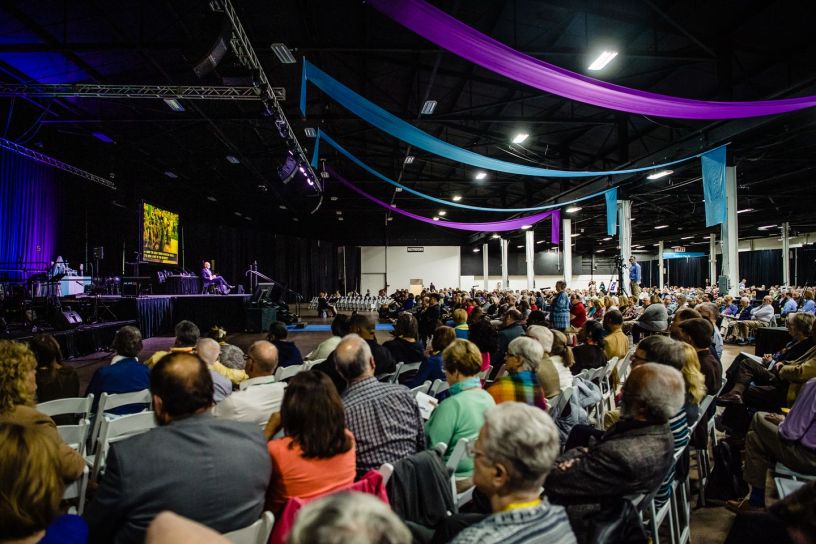
Delegates of the Eastern PA Conference of the United Methodist Church assembled for their annual session May 18-20, 2023, in Audubon, Pennsylvania, led by Bishop John Schol. The site is not far from Valley Forge, and the session represented about as low a point of morale for this part of the church militant as 1777 was for Washington’s army. It was the first time since 2019 the conference met in person, so there were many joyous reunions among old friends. The conference itself, however, was marred by an atmosphere of suspicion, heavy-handed episcopal oversight, and even a violent incident which prompted a call to the police.
Opening worship was excellent, with an inspiring message from Rev. James Lee, and high-quality music provided by the praise team, which continued throughout the conference. However, most of the worship team, as well as the preachers for both opening worship and the memorial service, were imported from Greater New Jersey (the other conference Bishop Schol leads). These optics seemed to confirm delegate suspicions that a merger of the two conferences was being forced without much input from EPA members – which found expression in a monitoring report Saturday morning. Rev. Alicia Julia-Stanley, co-chair of the Commission on Religion and Race, cited a perceived “lack of trust and transparency,” and shared delegate concerns that “we are being forced into a shotgun wedding all the way to the altar, but we haven’t had the pre-wedding counseling yet.”
Things began badly during the opening business session. Setting the bar of conference resulted in controlled chaos, as the limits were changed several times and delegates moved chairs around to squeeze into the approved space. Among the first resolutions was a sadly familiar one: the closure of five churches. What should have been a simple, if sad, decision was complicated when conference attorney Matt Morley offered an amendment from the floor, that the “annual conference supports and encourages the bishop, district superintendents and district boards of church location to utilize paragraph 2549.3(b).” This is the notorious paragraph which allows bishops to declare “exigent circumstances” and use local courts to seize the assets of a local church, recently invoked by the bishop of Eastern North Carolina to turn out the members of Wilmington’s Fifth Street UMC.[1]
Delegate pushback eventually prompted the bishop to have the proposed amendment withdrawn, and the closure resolution passed cleanly. The next morning, Schol apologized to the conference for complicating things, admitting that he had been behind the amendment, and explained that it would not apply to any disaffiliating churches, or even the 50 engaged in a lawsuit to leave the conference. The amendment was put up on the screen as a stand-alone resolution. Schol called for a vote, despite the fact that there was no particular person or committee named as sponsor, it had not been submitted in writing to the delegates beforehand as conference rules require, nor had it not been moved to the back of the line, after all the previously submitted resolutions had been addressed.
When a delegate rose to raise a point of order, the bishop passed over it and moved to a vote. It passed, though not by a large margin. Most delegates probably accepted Schol’s assurances that this would only, if ever, be applied in extreme circumstances. But he also admitted that the two congregations which had been stonewalling pastoral appointments (prompting the whole affair) had backed off and submitted. So why was it necessary? My suspicion: when, as I expect, the 2024 General Conference fails to protect traditionalist churches as leaders have promised, more will seek an exit from the UMC. Then Bishop Schol can say his conference is behind him when he uses 2549.3(b) to seize property and money from congregants who have sacrificed for decades to maintain their local ministry.
Also on Friday, a new strategic plan (or “direction”) was presented, with Bishop Schol and plan formulators sitting in a row of chairs, talk-show style, to discuss its importance – for a full hour. When delegate Dan Meter came to a mic to “call the question,” the bishop explained the plan was not yet properly before delegates as a motion. After ten more minutes of questions and comments, Schol recalled Meter to make his motion, instructing him that calling the question required a suspension of the rules to move to a vote – even offering specific wording for the motion. It passed, and the bishop then called for a vote on the plan without debate. When clergy delegate Robin Hynicka objected, Schol explained that having voted to suspend the rules, the required minimum tally of three speeches for and three against no longer applied. Schol could have counseled Meter to make a different motion, or otherwise paused the process to allow people to be heard. Instead, he moved to a vote and the plan passed, though by no means unanimously. Hynicka complained that this did not jibe with the oft-repeated assertion of “transparency” on the part of conference leadership.
On day three, things went further south. At the opening of business, Bishop Schol informed the body that on the previous afternoon, one delegate had grabbed another by the throat, prompting a call to the police, who expelled the man from the premises. Schol rightly declared that such behavior was unacceptable and would not be tolerated. But the incident was perhaps a sign of just how tense the atmosphere was.
Shortly afterward, the body renewed its discussion on the proposed conference budget, presented late the previous afternoon. Delegates across the theological spectrum had reservations about it, and a substitute resolution with an amended budget had been made. Schol began the renewed discussion by ruling that motion out of order, then stepped out from behind the presider’s desk to give a lengthy explanation to his reasons.
This was something he did frequently, distinguishing between his role as presider, where he is supposed to be impartial, and times when he stepped forward to simply “have a conversation” with the delegates as their bishop. It was a distinction many delegates found difficult to accept. In the monitoring report given that same day, Deacon Diana Esposito reported feedback from delegates their concerns over how “the bishop dedicated and expanded time to specific resolutions, and his bias in advocating for those resolutions.” She also noted delegate concerns that “the bishop’s power and authority rendered his preferences coercive to members on the floor when giving insight into motions or providing guidance for specific language.”
When he finally put the budget up for a vote, delegates lined up at the mics to make motions, ask points of order, or call for an adjourned session to have time for reflection and debate. Amid the parliamentary tangle, Schol abruptly ended debate a few minutes before 10 AM, declaring that the conference had run out of time, because preparations had to be made for the scheduled 10:30 ordination service. Murmurs and catcalls emanated from the assembly, including one loud voice, clearly audible even on the video recording, shouting, “This is why people are leaving your church!”
After pledging to hold a special session in the fall, Schol fulfilled a promise to clergy delegate Amy Banka, lead pastor of one of EPA’s largest churches, for three minutes of personal privilege. In a respectful, yet blistering critique, Banka took issue with messaging throughout the session that people in EPA were afraid of change. “We do not fear change,” she insisted, but healthy change “requires the kind of change management that discusses first and then acts; that meets around tables and not behind closed doors… The method matters!” She decried what appeared to many to be a takeover of EPA by Greater New Jersey with little input from Eastern Pennsylvania leaders, and declared, “We lament… statements and acts that insinuate that the best thing we have to offer Greater New Jersey is our newspaper. Hear our grief!”
After the reading of the appointments, the ordination service was held, Bishop Schol himself acting as preacher. Four persons were ordained and one commissioned – not nearly enough to take the places of thirteen elders and deacons who retired.
Thus ended one of the most demoralizing conference sessions we have ever experienced. Five churches were closed, and five more approved for disaffiliation. No budget was passed, and a number of resolutions were never considered before time ran out. The atmosphere of distrust – even disgust – was almost palpable, within a body that seemed both dispirited and exhausted.
When EPA Conference was formed in 1969 from the merger of the old Methodist and EUB conferences in the region, it boasted well over 600 churches. By the end of the 2023 session, there were about 370 – and that includes 50 congregations seeking an exit through a pending lawsuit. (By the way, exact statistics are hard to establish, since we have not had a conference journal published since 2020). Of those 370 churches, we were told during the strategic plan presentation that only 18%-25% of them are considered “vital.” According the GCAH website, EPA has lost nearly 27% of its membership between 2012 and 2021, and attendance fell during that same period by a whopping 59.7%.[2]
The decline of Eastern Pennsylvania is a microcosm of trends in the larger United Methodist Church in the US. Lack of unity on core doctrinal issues, clerical defiance of the Book of Discipline, administrative incompetence, and agenda-driven episcopal leadership, have pushed a once-great institution to the brink of collapse. No wonder the GCFA recently reported a one-year loss of more than 570,000 members in 2021, and more than 5,000 US churches have already left the UMC through disaffiliation.
God have mercy on the United Methodist Church!
——————————————————————————————————-
Rev. Joseph F. DiPaolo is a clergy member of the Eastern PA Conference of the UMC, and also a member of the Wesleyan Covenant Association’s Global Governing Council. For the EPA Conference’s official summary of its session, as well as videos of all the proceedings, see https://www.epaumc.org/2023-annual-conference/.
[1] https://juicyecumenism.com/wp-content/uploads/20230327-Fifth-Avenue-Press-Release-Approved-for-release-to-media.pdf,
[2]http://www.umdata.org/ChartViewer.aspx?&Width=500px&height=500px&Data=MembAtt&seriesname=MembershipAttendance&confNo=350&Title=Membership%20/%20Attendance&level=Conference&GBNO=C35000&StartYear=2012&EndYear=2022
 People Need Jesus
That is so sad to see.
It was far from. Conferencing and far from Christian. It was also not Methodist or United. It was a travesty.
Thanks for sharing.