
by Chris Ritter
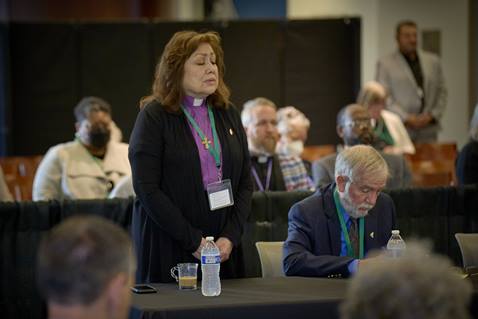
After an eighteen-month suspension, Bishop Minerva Carcaño was ruled not guilty on charges of disobedience to the Discipline, undermining the ministry of another clergy, harassment, and fiscal malfeasance. The testimony on behalf of the church centered on the hiring of her daughter as a district assistant, living accommodations in a San Francisco area parsonage, and a clergy who alleged she was not allowed to plant a church because of her pregnancy. Defense counsel Scott Campbell stated what many of us were thinking when the prosecution’s case rested: “Is that it?” The unprecedented and extremely public trial of a bishop seems a disproportionate response to matters of administration open to various interpretations.
Once the speedy jury verdict was announced, I better understood why Bishop Carcaño requested a change of venue away from the Western Jurisdiction. The trial pulled back the curtain on a highly dysfunctional clergy culture endemic to the West and, increasingly, the American UMC at large. The bishop’s assertive leadership style cut against an entrenched spirit of clergy entitlement. Focusing on the gender and race issued at play, the United Methodist Insight editorial board issued a statement that concluded: “The trial of Bishop Carcaño has exposed the worst of the UMC: its nit-picking hidebound rules, its mean-spirited infighting, its preoccupation with minutia, its lust for power, its absence of grace.” If the charges were nitpicking and motivated by race, why were they not dismissed months ago by the Western Jurisdiction bishops so empowered?
Although trials involving bishops are extremely rare, complaints against bishops are not. When Karen Oliveto was elected to the episcopacy by the Western Jurisdiction as the UMC’s first openly gay bishop, there were a number of challenges. The UMC Judicial Council (supreme court) ruled in 2017 her election violated the Book of Discipline, but left it to the Western bishops to act upon that ruling… which they passively refused to do. When Bishop Melvin Talbert (a Western bishop who only recently passed away), officiated a same-sex wedding in Alabama against the wishes of the resident bishop, the Council of Bishops actually invited complaints. They seemingly did so in order to insure the Council controlled both the prosecution and defense. The charges were dropped in 2015 as a “just resolution” was announced. With so many mechanisms to avoid accountability, why wasn’t the UMC’s first Hispanic female bishop likewise protected by her colleagues instead of dragged before a jury? We might conjecture it was the “Ghost of Glide.”
San Francisco’s Glide Memorial UMC was once the largest church in the Western Jurisdiction. Wikipedia describes its heyday as a “10,000-member congregation of all races, ages, genders, ethnicities, sexual orientations, and religions. It is the largest provider of social services in the city, serving over three thousand meals a day, providing AIDS/HIV screenings, offering adult education programs, and giving assistance to women dealing with homelessness, domestic violence, substance abuse, and mental health issues.” Glide served the Tenderloin District of the city with the reputation as a place where the wealthy tech executives and celebrities rubbed elbows with the homeless in large, concert-style “Sunday celebrations.’ Classes on Buddhist meditation were easy as Bible studies to find at Glide, United Methodism’s cathedral of progressive faith.
Glide happens also to be the congregation from which Karen Oliveto was elected to the episcopacy. Carcaño filled the vacancy with Jay Williams, another gay clergy. Williams resigned in 2018… less than a year after his appointment. He objected that the church was actually run by long-retired Pastor Cecil Williams (no relation) through the “Glide Foundation.” Glide’s subsequent rejection of Carcano’s replacement for Jay Williams triggered the bishop to look more deeply into Glide’s inner workings. She discovered that that Holy Communion had not been celebrated in years and the church baptized only in the “name of Glide,” not in the name of the Trinity. The church was in blatant noncompliance with organizational standards of the denomination. Carcaño described Glide’s “Sunday Celebrations” as “uplifting concerts,” which “lack the fundamentals of Christian worship.”
Bob Phillips reported: “The multimillion-dollar Glide Foundation assets had been transferred out of United Methodist control at the end of Cecil Williams’ tenure in 2000, and until very recently paid Williams and his wife roughly $400,000 annually for consultation. Subsequent lead pastors/ bishops collaborated with these moves, ensuring the end of accountability required by the Discipline. Carcaño announced no clergy would be appointed, since Glide was no longer a functioning United Methodist Church.”
It was an embarrassment to the Western UMC that the “highly qualified” Karen Oliveto was outed as presiding as a figurehead over Glide. Progressives vilified Carcaño during the Cal-Nevada Conference lawsuit that ensued. Several clergy protested the bishop’s actions as the larger community in San Francisco sided with Glide against a “conservative” bishop. A 2021 agreement officially ended Glide’s association with the UMC along with the litigation over assets.
The progressive, LGBTQ+ affirming Carcaño was not progressive enough for the Western Jurisdiction or its clergy. She expected, at least on some level, for United Methodist churches to be… United Methodist. The recent trial is evidence that the ghost of Glide came back to haunt her. Even her Western Jurisdiction episcopal colleagues seemed willing to hang her out to dry. UM Traditionalists have long worried that there will not be a place for them in the emerging UMC. Starting on the coasts, progressives with even an inkling of moderating instincts should perhaps be likewise concerned.
 People Need Jesus
Thank you for the write up. I had been quite confused about all of this… mainly because of the suspension length and vague details, plus I suppose you could say I never really followed “Methodist news” on a national level too closely. I somehow missed the Glide controversy entirely (still had my credentials back then).
From what I can tell, my friends who are still a part of the UMC have mixed feelings on the verdict. Some articulate similar concerns you raise. Others adopted a rather vindictive narrative some UMC media outlets promoted. I wonder what the ripple effects will be in the years to come.
This is incredibly skewed and misinformed. There are sweeping statements that have absolutely no grounding. I’m very disappointed by those that make statements about this situation that truly don’t know what’s happening.
Happy to correct any relevant omissions or errors of fact.
There were many victims. I know of one pastor, after speaking up, who has been placed on “medical leave” since December 2020. Another has left the church altogether. In yet another case, crimes committed at a local church were ruled “an administrative matter of the local church” even though two felonies were litigated in a Contra Costa County courthouse.