

by Chris Ritter
Global Methodists are on something of a honeymoon. Our gatherings are warm and spiritual, tinged with elation, even, as the former weight of denominational discord has dropped from our shoulders. Although Tom Rainer christened us “America’s fastest growing denomination,” sober moments remind us that we are a growing movement of mostly declining churches. We inherit congenital ailments from decades of identity loss, institutionalization, and cultural captivity. Passing through the fire of individual disaffiliations had a refining effect, for sure. No congregation defaulted into the GMC. We are a voluntary company, uniformly desirous of a vital expression of Wesleyan faith. The various renewal impulses (Creedal, Evangelical, Charismatic, Structural, Liturgical) swirl around the target of what Wesley called “primitive Christianity.” But this swirl makes us dizzy. What good things should we keep? What lost things should we recover? What comfortable habits should we kick? Could it be that we really don’t know Methodism well enough to recover it?
The steeper the decline, the stronger the medicine needed. “United Methodism 2.0,” “UMC Lite,” or “Mainline, but Conservative” options are not going to cut it, especially if we really want to become an insurgent movement again. Our current U.S. decline is a Stage Four carcinoma, attached to all our systems. If Kevin Watson is correct (as I believe he is) the roots of this malady go much deeper than 1968. Methodisms, North and South, were both culturally captive by the 1939 reunification. That means our identity crisis is at least a century old. Add to this that we are not getting any younger, demographically speaking. Like Benjamin Button, the GMC is born old.
Magical thinking tells us that right doctrine brings revival. It does not. Essential as it is, doctrine cannot bring the change we need. Wesley said the Anglican Church of his day had the best doctrine of any church in history. Yet it was dead, and “There is nothing so dead as a dead orthodoxy.” The move of the Spirit known as the Methodist/Evangelical Revival was a movement of praxis. As General Conference prepares to meet, we should look to spark change in actual behaviors at the personal and congregational levels.
Three Complicated Rules
The General Rules of the United Societies are the original statement of Methodist praxis. After outlining the method of meeting together, the Rules vow to avoid evil, “especially that which is most generally practiced.” There was no need to mention adultery and other sins all Christians agreed to be wrong. The General Rules attack “churchy” sins, naming laxness in words, commerce, and Sabbath-keeping. Sins tolerated among the Anglicans would not be tolerated among the Methodists. But the General Rules do not describe a life of cold-hearted abstinence. They also contain an accompanying list of good works that evidence salvation. We are to do good to all… whether we feel like it or not. Finally, there is a commitment to rigorous practice of the means of Grace, the ordinances of God. The General Rules are an indictment of lackadaisical belief-ism… a call to action. This is why the venerable Bishop Job’s modern interpretation of them (Three Simple Rules) is inadequate. They were never intended to be simple. They are meant to be distinctive, measurable, and mortifyingly difficult. “Do no harm, do good, and stay in love with God” beds Methodism back down into the moral platitudes and routines of the State Church from which it awoke.
In United Methodism, the General Rules fell into the shadowy realm of historical documents preserved, but no longer in practical effect. United Methodist clergy vow to keep the General Rules, but many have never even read them. They are doctrinal standards for the whole church, but United Methodists are not expected to agree to them at the point of church membership. The are, admittedly, dated. The Free Methodist Church has replaced the General Rules with a detailed “Confession and Commitment” membership statement built into their Constitution (Pars. 156-160). The Wesleyan Church has similarly revised the General Rules into “Guides and Helps for Holy Living,” found as Article III in their church constitution.
In the Salvation Army (an offshoot of British Methodism), the defining statement of praxis was drafted as “The Articles of War,” today known as the Soldier’s Covenant. As with the General Rules originally, it is for the whole church and must be signed for membership. After several statements of belief, the Covenant concludes with ten “I will” statements, covering personal piety, stewardship, abstinence from alcohol and drugs, and the sanctification of family life.
David Watson submitted a petition to the convening General Conference that would commission a reworking of the General Rules for the Global Methodist Church (see here and here). Watson wants to preserve the “core values of the historic General Rules… while better addressing today’s realities, being intentionally globally applicable, and focusing on commitments we realistically expect all of our clergy to actually keep when they promise at their ordinations to ‘keep the General Rules of our Church.'” We might note here how most Global Methodists, clergy and laity alike, taste alcohol, go to restaurants on the Sabbath, and wear gold jewelry. We either need to change the General Rules or change ourselves. Better still, we should do both.
Methodists Attacking Decline
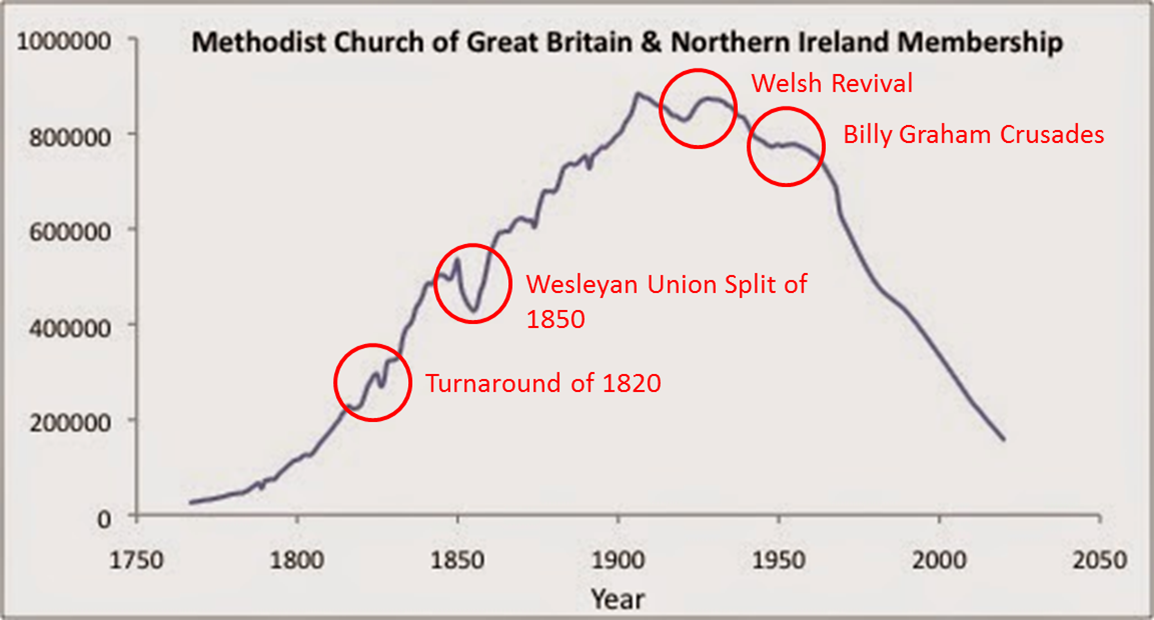
Nearly a decade ago, I came across the minutes from a pivotal moment in British Methodism. The 1820 Liverpool Conference was alarmed by the first-ever recorded decline in Methodist membership. A generation after the death of Wesley, a 19th Century Golden Age of Methodism was far from assured. Just as Asbury and company re-booted Wesleyanism for the U.S. frontier, British Methodists created a renewing program of praxis that would lead to decades of expansion. “The Liverpool Minutes” are slowly being rediscovered as a tool toward Methodist vitality. My original post on the Liverpool Minutes was translated into Korean. Friends in the UK planned a 2020 event inspired by my post. Now that the Global Methodist Church is a reality, I think it is time to take a fresh look at the statement of praxis that formed the original Methodist turnaround strategy.
Unlike the General Rules, the Liverpool Minutes are for clergy. Renewal most often begins with the leaders themselves. It might be fair to say the Minutes are an heir of Wesley’s “Rules of a Helper,” a 1744 praxis statement for preachers. The “Let Us” statements of the Minutes recommit the preachers to “Personal Religion and to the Christian instruction and government of our own families.” Their preaching was to refocus on the Evangelical doctrines of the Faith: Repentance, Faith, Justification Assurance, and Sanctification. The practice of field preaching was reclaimed. Regular times of prayer and fasting were scheduled. Ministry was to be expanded to new locations, with local leadership resources shifting to enable these efforts. Renewed emphasis on ministries with children and youth was prescribed. The existing members was to re-evangelized, with visits made to the careless and lukewarm.
Perhaps the real secret to the success of the 1820 Liverpool Minutes was the determined follow-through. In 1821 and 1822, the preachers revisited and reaffirmed the plan. These conferences particularly commended the continued practice of prayer, fasting, and band (accountability) meetings. For decades, British Methodist preachers stood annually to recite all 2650 words of the Liverpool Minutes aloud (It took over twenty minutes) as they renewed their calling to keep the original flame alive. (Those words are printed below as an appendix.) British Methodists eventually revisited and updated the Liverpool Minutes into the current “Resolutions on Pastoral Work” in 1885.
Following the Liverpool Conference, British Methodism tripled in numbers over the next eighty years and proved it could continue without the direct leadership of its founder. Of course, decline eventually did come to the British Methodists and, apart from the Welsh Revival and help from Billy Graham Crusades, the decline has continued unabated since the dawn of the 20th Century.
Conclusion
Dogged determination is necessary to defeat decline. The kind inherited by the Global Methodist Church cannot be cast out, except by prayer, fasting… and hard work over many years. We need something like the resolutions found in the Liverpool Minutes to keep us focused on a program of reform and expansion. It might be worthwhile to have both a toothsome membership covenant AND a measurable clergy covenant to renew our ministries, spur holy living, focus us outward, and call us back to the original altar from which our flame was lit.
APPENDIX:
The Liverpool Minutes
- We, on this solemn occasion, devote ourselves afresh to God; and resolve, in humble dependence on his grace, to be more than ever attentive to Personal Religion, and to the Christian Instruction and Government of our own families.
- Let us endeavor, in our public ministry, to preach constantly all those leading and vital Doctrines of the Gospel, which peculiarly distinguished the original Methodist preachers, whose labors were so signally blessed by the Lord, and to preach them in our primitive method, — evangelically, experimentally, zealously, and with great plainness and simplicity; giving to them a decided prominence in every sermon, and laboring to apply them closely, affectionately, and energetically to the consciences of the different classes of our hearers.
- Let us consecrate ourselves fully and entirely to our proper work, as servant of Christ and his Church, giving ourselves “wholly” to it, both in public and in private, and guarding against all occupations of our time and thoughts, which have no direct connection with our great calling, and which would injuriously divert our attention from the momentous task of saving souls, and taking care of the flock of Christ.
- Let us “covet earnestly the best gifts,” to qualify us for an acceptable and useful ministry; let us seek them in prayer from Him who is the Father of Lights and the Fountain of Wisdom; let us “stir up,” and improve by study and diligent cultivation, “the gift that is in us,” and strive in every way to be “workers who need not be ashamed, rightly dividing the Word of Truth;” — taking care, however, that whatever other qualifications we may acquire and use, our Ministry shall, at least, by the Divine blessing, be always characterized by sound, evangelical doctrine, by plainness of speech, and by a spirit of tender affection and burning zeal.
- Let us frequently read, and carefully study, Mr. Wesley’s Rules of a Helper, and other parts of the large Minutes which relate to the duties of a Preacher and Pastor.
- In order to promote an increase of the congregations, and a revival of the work of God, let us have recourse, even in our old established circuits, to the practice of preaching out of doors; seeking, in order to save that which is lost.
- In every Circuit, let us try to open places; let us try again places which have not been recently visited; let us be increasingly attentive to the supply and superintendence of the country places already on the Plan; let us not be satisfied until every town, village, and hamlet, in our respective neighborhoods, shall be blessed, as far as we can possibly accomplish it, with the means of grace and salvation; — In a word, let every Methodist Preacher consider themselves as called to be, in point of enterprise, zeal and diligence, a Home Missionary, and to enlarge and extend, as well as keep, the Circuit to which they are appointed.
- Let us, wherever it shall appear to be practicable, especially in the old and large [congregations], employ some active and zealous persons, whose piety and general character shall be approved by the Leader’s Meetings, to attempt the formation of new classes, in suitable neighborhoods, where we may hope by that method to gather into the fold of Christ some persons who are “not far from the Kingdom of God,” but who need special invitation, and are not likely to “give themselves” fully “to the Lord and to us by the will of God” without more than ordinary labor and spiritual attention.
- Let us speak plainly and pointedly in every place, both in those occasional meetings of the Society at which strangers are allowed to be present, and in our sermons, on the duty and advantage of Christian Communion; and exhort all who are seeking salvation, to avail themselves, without delay, of the help of our more private means of grace.
- Let us encourage public Prayer Meetings, especially those which are help at times which do not interfere with our general worship, in the houses of our friends, in different parts of a town or neighborhood; such meetings having been long proved to be , when prudently conducted by persons of established peity and competent gifts, and duly superintended by Preachers, and by the Leaders Meetings, valuable nurseries for our Congregations and Societies, and means of salvation to many who could not have been reached at first by any other method.
- In country places, where a fully supply of preaching cannot be obtained, either by Traveling or Local Preachers, let suitable persons, belonging to the nearest Societies, be encouraged to attend, under the direction of the Superintendent, for the the purpose of public Prayer and Exhortation, and occasionally be read to the congregation a short and plain Sermon on the First Principles of the Doctrine of Christ, until such places can be favored with other and more regular opportunities of instruction in righteousness.
- Let us ourselves remember, and endeavor to impress on our people, that we, as a Body, do not exist for the purpose of party; and that we are especially bound, by the example of our Founder, by the original principle on which our Societies are formed, and by our constant profession before the world, to avoid a narrow, bigoted, and sectarian spirit, to abstain from needless and unprofitable disputes on minor subjects of theological controversy, and, as far as we innocently can, to “please all persons for their good until edification.” Let us, therefore, maintain toward all denominations of Christians, who “hold the head,” the kind and catholic spirit of primitive Methodism; and, according to the noble maxim of our Fathers in the Gospel, “be friends of all, and the enemies of none.”
- Let us, at least in every large town, establish weekly meetings for the children of our friends, according to our ancient custom; and let us pay particular attention, in public and private, to the young people of our Societies and Congregations.
- Let us meet our Societies regularly on the Lord’s day; and frequently on the week-day evenings, in country places, where we do not preach on the Lord’s day: — Let the members be accustomed, on such occasions, to show their Society Tickets; — and let us endeavor to make these meetings interesting and appropriate to our members, as such, — by giving to our addresses an immediate reference to the state of the people, to the circumstances of each Society, and to their peculiar duties: both personal and domestic, as professors of religion, and as Methodists, and be frequently explaining and enforcing our own Rules.
- Let us revive, where it has been neglected, and promote in every place, the observance of those parts of our discipline, which refer to Watch-nights, Private and Public Bands, and Quarterly days for solemn Fasting and Prayer.
- Let us, wherever we have access and opportunity, be diligent in pastoral visits to our people, at their own houses, especially to the sick, the careless, and the luke-warm.
- But as such visits much, in many cases, from our plan of continual itinerancy and village preaching, and from the number of members in the larger Societies, be greatly limited, let us endeavor so to arrange in our several Circuits the Plans for the Quarterly Public Visitation of the Classes, as to allow full time for the more minute examination into the Christian knowledge, experience, and practice of the Members, and for the pastoral inquiries, instructions, and counsels, respecting personal and family religion.
- Let us regularly meet the Class Leaders and examine their Class Papers in town and country and do all we can to engage both them and our respective Brethren the Local Preachers to co operate with us in their respective departments in promoting vital godliness among our people and extending the work of the Lord.
- As much depends under the blessing of God on the piety knowledge zeal activity and Christian temper of our Leaders as well as on their firm attachment to the doctrines discipline and cause of Methodism let us never nominate a new Leader until we have conscientiously satisfied ourselves by previous inquiry and personal examination as to the character and qualifications of the person proposed and let us act uniformly on the Rule respecting the Public Examination of Leaders which is found in our Minutes of 1811.
- Let us whenever a new Leader nominated by us and accepted by the Leaders Meeting shall be first introduced into the Meeting take that opportunity of stating the duties which belong to the office and of enforcing them on all present
- Let us affectionately but firmly enforce on the Leaders as an essential article of our pastoral discipline and one which in consequence of our own constant itinerancy cannot be dispensed with the Rule of the Society in which it is stated to be the duty of a Leader to see every Member in his Class once in every week
- Let us pay particular attention to Backsliders and endeavor in the spirit of meekness to restore them that have been overtaken in a fault and by private efforts as well as by our public ministrations to recover the fallen out of the snare of the devil.
- Let us afresh enforce on all our people a conscientious attendance on the Lord’s Supper
- Let us earnestly exhort our Societies to make the best and most religious use of the rest and leisure of the Lord’s Day let us admonish any individuals who shall be found to neglect our public worship under pretense of visiting the sick or other similar engagements let us show to our people the evils of wasting those portions of the Sabbath which are not spent in public worship in visits or in receiving company to the neglect of private prayer of the perusal of the Scriptures and of family duties and often to the serious spiritual injury of servants who are thus improperly employed and deprived of the public means of grace let us set an example in this matter by refusing for ourselves and for our families to spend in visits when there is no call of duty or necessity the sacred hours of the holy Sabbath and let us never allow the Lord’s Day to be secularized by meetings of mere business when such business refers only to the temporal affairs of the Church of God
- With a view to promote in the families and schools of our connection the uniform and regular practice of catechetical instruction which especially in the present state of our body and of our country at large we deem to be of the highest importance we agree that a series of catechisms shall be prepared and recommended for general use among us and we earnestly request Mr Benson and Mr Watson to draw up such catechisms and to submit them to the examination of the next Conference
- In conducting our leaders and quarterly meetings and all other official meetings amongst us let us affectionately and steadily discountenance the spirit of strife and debate and promote in the management of all our affairs both by our advice and example the temper and manner of men who are acting for God in the service of His Church Let the introduction of all topics of useless or irritating discussion not legitimately connected with the proper business of such meetings be prudently repressed Let us remember that in a large body the only way to live in peace and comfort is to walk by rule and to use the language of Mr Wesley not to mend our rules but to keep them for conscience sake And while we readily and cheerfully protect all our members in meetings in which we preside in the exercise of such functions as belong to them according to our laws and general usages let us not forget that we are under solemn obligations to conduct ourselves on such occasions not as the mere chairmen of public meetings but as the pastors of Christian societies put in trust by the ordinance of God and by their own voluntary association with us with the scriptural superintendence of their spiritual affairs and responsible to the Great Head of the Church for the faithful discharge of the duties of that trust
- We affectionately exhort those of our own people who are laudably active in various benevolent institutions while they persevere in every good word and work to guard against the danger of expending all their leisure and influence to mere local and subordinate charities so as to neglect God’s own direct and immediate institutions such as the public preaching of the Gospel or to deprive themselves of the opportunity of regularly attending their classes and of private prayer and reading of the Holy Scriptures It should not be forgotten that the great spiritual work of God depends under the Divine blessing on the general and conscientious use of His institutions and that in the success of that work all other good undertakings among us had their origins and must ever have their principal support These things ought ye to have done and not to have left the other undone
- In order that the state of the work may be constantly under the eye of the preachers we agree to revive uniformly the good old custom of keeping quarterly schedules in every circuit each of which shall contain a correct statement for the quarter to which it belongs of persons admitted on trial new members fully admitted into society after due probation removals into other circuits deaths backsliders conversions number in the bands and total number of members then in the Society The book steward shall prepare and furnish to every circuit a sufficient number of printed forms of such a schedule to be filled up by the preachers in reference to every distinct class during their quarterly visitations And from these each Superintendent shall draw up every quarter one general schedule containing an account of all the societies in his circuit in relation to the several particulars above mentioned These general circuit schedules each Superintendent is expected to produce whenever required so to do at the annual district meeting or at the Conference
- Every Superintendent is required to leave for his successor in the circuit book not only a list of the town and circuit stewards and of the annual subscribers to our several funds &c but especially an exact list of the names of all the members in his circuit arranged in their several classes and societies as found at the preceding Midsummer visitation
- But as we are deeply sensible that the great thing to be desired in order to a revival and extension of the work of God without which no resolutions or labors or regulations will avail is a new and more abundant effusion of the Holy Spirit on ourselves on our societies and on our congregations we solemnly agree to seek that blessing in humble and earnest prayer And we hereby appoint that the day of the next quarterly fast namely the Friday after Michaelmas Day October 6th shall be observed in all our circuits as a day of special fasting and prayer to Almighty God Let meetings for public supplication be held in as many places as possible in every circuit and let the preachers speak largely and particularly on the subject of their sermons on the preceding Lord’s Day
- The various articles included in this Minute shall be read by every chairman at the next regular annual meeting of his district and shall then be made the subject of serious conversation among the brethren with a view to their particular bearing on the spiritual state and circumstances of each district respectively.
 People Need Jesus
Love this
Well done Chris. You are