
by Bob Phillips
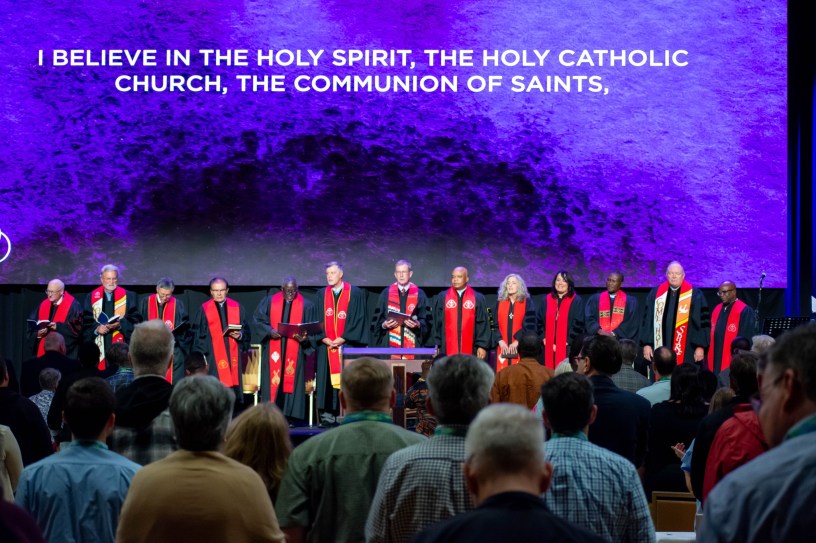
The convening general conference of the Global Methodist Church has completed its business in San Jose, Costa Rica. I attended this event as a marshal and sat through the sessions amid discussion, worship, prayer, and dialogue. I had served as a delegate to the United Methodist General Conferences in Portland OR and in St. Louis MO. The contrasts beggar the power of description, and in good ways.
Chris Ritter, David Watson and Joe DiPaolo are among those with responses rich in insight to Costa Rica GC24, and I bow with gratitude in their direction (all can be read at peopleneedjesus.net). I offer the following takeaways in making sense of what happened from my seat in the stands. These are not final judgments but reflect the initial response I had spiritually, intellectually and emotionally to the events I witnessed, the words I heard, and the people with whom I interacted.
First, I was impressed with the focus of the General Conference. Some such gatherings are reminiscent of the man “who mounted his horse and rode off in all directions.” Other such events, like an old Western potboiler, seem like an extended ambush or a continuous series of shoot-outs. Such was not this event. The difference between the truly important and there merely urgent was maintained. Defined priorities quickly emerged and were addressed. A disciplined yet gracious focus ruled the day and the dais.
Thus, a new constitution was needed and was passed, the fruit of serious effort by those working from unity but not uniformity. After in-depth discussions, the number, the process and the nature of episcopal leadership were defined. A mission and vision statement reflecting the on-the -ground realities of Global Methodism were adopted. Persons from the entire global Methodist family were identified and selected to fill initial positions of leadership. The Global Methodist Church was launched with clarity and coherence.
I was encouraged by the line-of-sight connection between the decisions made and the compelling actual challenges the Global Methodist Church must confront. The priorities established reflected reality in the stand up of a new Wesleyan denomination. Distractions were minimized both in discussion and in action. Secondary and irrelevant matters stayed secondary and irrelevant. The assembly refused to be submerged in 10 feet of words or buried in the pious gobbledygook of gaseous paper pronouncements.
I appreciated the innovation of the Global Methodist process to include delegates from outside the United States, especially but not only Africa. A process was found with accountable effectiveness to ensure that African delegates who were unable to acquire last minute visas could still participate in the conference with voice and vote. Neither identity politics nor quotas drove any of the processes or decisions. The Spirit clearly oversaw the process and representation was clear.
I appreciated the commitment to a shared grace. After serious deliberations, a vote was taken in committee that preferred a particular approach to the office of Bishop. The major alternative approach could have been presented as a minority report but those who had worked hard and faithfully on that minority approach decided not to submit it as a minority report. Potentially raucous floor debate was rendered irrelevant, but not “suppressed,” since the option did remain. The integrity and the transparency of the process, i.e., no hint of stacking the deck for a pre-selected outcome, deepened the trust. Unity was thus confirmed but not conflated with uniformity.
I was uplifted by the authenticity and passion of worship. I am a more cerebral type and tend to view emotional worship with some level of distance. I do not naturally or easily raise my hands in worship. What I experienced in Costa Rica was the real deal. The genuine spirit with which the delegates united to worship was beyond question inspired by the Holy Spirit. The passion and intensity of worship were consistent, unmistakable and genuine. Times of kneeling in place, altar moments, and similar expressions were “spontaneous and unrehearsed.” When Bishop Webb began his sermon by introducing himself through the affirmation of the Creed, everyone was caught up in the identity of the One of whom the Creed speaks and the reality of the living God.
J. Gresham Machen, in his book Christianity and Liberalism, opined that the liberalism of the 1920’s differed from historic Christianity in its rejection and/or marginalization of Christianity as a supernatural faith. Liberals take the great teachings concerning Christ “seriously but not literally,” hence no literal miracles, virgin birth, atoning death on the cross, resurrection, ascension or Second Coming, and no Holy Spirit as described at Pentecost. The “Holy, Holy, Holy” worship encounter of Isaiah with the living God (in Isaiah 6) did not really happen in an authentic objective sense because such notions are superstitious. This approach, even when sprinkled among those who do hold traditional faith, clearly influence and infect the nature and intensity of corporate worship. Holy transcendence leaves the room, replaced by a tasteless brew of contrived excitement and predictable scripts.
N.T. Wright, in his masterful work, History and Eschatology: Jesus and the promise of natural theology, sees a rise of modern Epicurean faith nudging supernatural Christianity aside in much modern Protestantism. It is a re-packaged version of Machen’s 1920’s liberalism, dismissive of transcendent realities as objectively true, shifting focus to this-worldly matters as the only real or relevant domains for a ‘modern’ Christian. Wright sees this shift as wildly unfaithful to the biblical witness. Spiritual passion rooted in worship of a truly-resurrected Christ is a first casualty when such assumptions seep into the gathered church. A little Epicurean leaven spoils the Bread of Life of worship for all. Costa Rica worship reflected what happens when everyone is on the same page insofar as the essentials of faith are concerned. The consistent quality of worship, for me, was a clear signal that old-school liberals and modern Epicureans missed the flight to Costa Rica and can find no room to take root in the Global Methodist Wesleyan way. For that, and for the witness of the Global Methodist GC2024, I simply affirm: “Thanks be to God, who has given us the victory through our Lord Jesus Christ.“
Degrees from University of Illinois, Asbury and Princeton Seminaries, University of St. Andrews
Graduate of Senior Executive Seminar on Morality, Ethics and Public Policy, Brookings Institution
Captain, Chaplain Corps, US Navy (ret)
See Bob’s work on Methodist Mitosis in Methodist Review.
 People Need Jesus
The last two paragraphs are pure gold. Thank you!
Thank you, Doc
Thank you for an excellent reporting on the Convening General Conference of the Global Methodist Church! As a participant and presider over the 2nd Session, your report matches my perceptions.
Bishop Emeritus Mike Lowry
THanks