
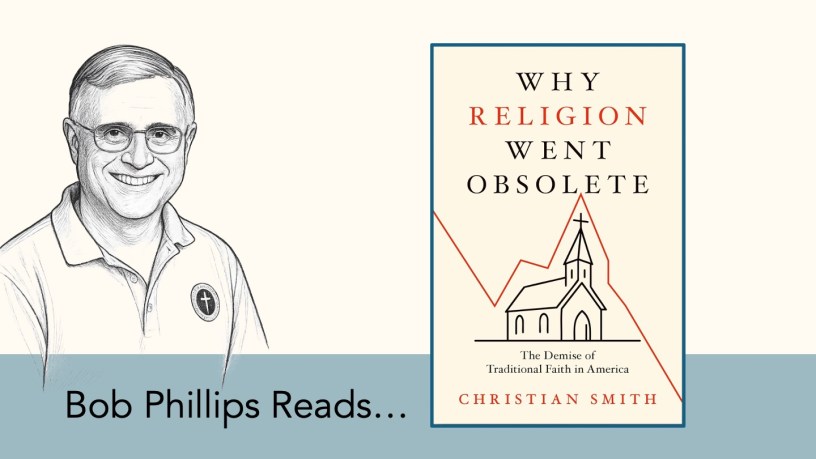
by Bob Phillips
In October 1862, photographer Matthew Brady opened a display in his Manhattan studio, entitled, “The Dead of Antietam.” The gallery included graphic scenes of dead soldiers and animals from this Civil War battle, which was at that time the bloodiest single day of warfare in U.S. history. A reporter from the New York Times wrote in his review, “Mr. Brady has done something to bring home to us the terrible reality and earnestness of war. If he has not brought bodies and laid them in our dooryards and along the streets, he has done something very like it.”
In Why Religion Went Obsolete: The Demise of Traditional Religion in America (Oxford University Press, 2025), Christian Smith, Professor of Sociology and Religion at Notre Dame, has taken an in-depth view of the state of American organized religion. The work is well-researched, detailed, and offers those active in the American church an experience of ecclesial blunt force trauma. “If he has not brought the bodies (of organized religion) and laid them in our dooryards and along the streets, he has done something very like it.” The title of the book makes clear that sacred spin, or a verbal rain dance of denial are not on the menu. This, in short, is a tough but necessary read for those committed to the church of Jesus.
I offer three notes at the outset. First, Christian Smith is, well, a Christian, a practicing Catholic, with prior Protestant pedigree from Wheaton and Gordon colleges. In this, as in his previous works on sociology and religion, he acknowledges his faith, even as he is clear to add that his conclusions are driven by data and research and will not be skewed improperly by his faith. Second, it is crucial to read his work from the perspective of one’s own tribe. As a traditional “orthodox” Global Methodist, I occasionally found myself toying with the giddy temptation to read parts of Smith’s work and smugly react about how the mainline United Methodist organization was toast. The problem, of course, is that plenty is this book can keep Global Methodists or adherents of any church up at night, be they liberal or conservative, liturgical or line dancers. The hurt locker is big enough for all. Deal mainly with how it speaks to me, not to thee. Third, Smith is talking about religion in the US, not global Christianity (or Judaism or Islam, etc.). Some issues do overlap with the wider view, but the state of US religion is the core.
Smith’s thesis is simple. Profound, systemic and multi-layered shifts in culture have combined to move organized religion, church membership/participation, into the status of irrelevance for a growing number of Americans, especially but not limited to younger adults and teens. For many, in numbers soon to encompass most, the organized church is moving toward an identity like the proverbial “one hoss shay,” as functionally obsolete as the buggy as a mode of transportation…in this case, irrelevant in making connection with God in the American culture. To many in modern culture, arguing for the need for organized religion is comparable to arguing for the necessity of growing a third thumb. Good luck proving relevance.
Why the Shift?
I highlight four sample clumps of data and interpretation to illustrate the issues. Smith lists six qualities that American culture expects from and values in religion. Ideally, awareness of these expectations can aid a church to align its practices with sensitivity to these assumptions. First, religion is expected to instill morals, “to make people good,” especially among children but applicable to all. While many also believe that one “can be good without God,” its value in nurturing noble moral character is affirmed as a cultural expectation. Second, religion can provide people ‘with emotional and psychological support,” or as the black spiritual describes the balm in Gilead, “to make the wounded whole.” Third, “religion is good when it fosters community, social cooperation, peace and harmony,” a movement that builds bridges in the culture rather than burning them. Fourth, religion is expected to provide modeling, admirable examples of people of character, compassion and integrity. Fifth, religion is expected to be a source of moderation, “not too weird and certainly not fanatical or extremist,” thus ruling out Jonestown, Scientology or the Branch Davidians. Sixth, religion is good when it nurtures national solidarity, not in the Christian nationalism mode, but in affirming noble qualities that unifies the nation’s heritage in a healthy and honest appreciation of America. Organized religion is expected to meet or exceed expectations in these areas by most citizens, whether or not the individuals are active in organized religion.
Second, major cultural changes have combined to push the church toward obsolescence. Examples include the failure to adapt and innovate amid profound cultural change; “crowding out” of the church by the state and secular agencies from key roles once in its purview (think colleges, hospitals, care for the poor); the rise of “professional control over expert knowledge.,” in which the church no longer is viewed as a key source of knowledge about life, values, families or ethics. The dramatic drop in fertility is huge and has deprived organized religion of several traditional motives for younger adults and their growing families to seek a church home. The strong growth of individualism and the “downplaying of transcendence” have lessened motivation to take active interest in anything a church may have to say. Consider also, “almost every traditional religion in the United States is organized on the pre-internet model of centralized, top-down administration,” reinforcing institutional irrelevance in the evolving modern culture.
Third, much organized religion has done a painfully fine job of creating self-inflicted wounds. Smith offers several pages of an extended list of the highly public moral crash-and-burn stories of leading religious figures. While Smith takes pains to rebut the false claim that religion is the oldest enemy of science, the negative perception of religion’s approach to science, to sexuality, and to politics have done the cause no good. Every time a church (on the religious right or left) shares a bed with a political cause (on left or right), a price is paid in credibility and witness. This is not a call to step back from prophetic or justice ministries, but if a denomination’s social teachings read like the left wing of the Democratic party or the right wing of the Republican party at prayer, there is a problem. If moral failures are rationalized or dismissed, the unsaved will shrug off the church.
Fourth, face the profound negative impact of the web/wired generation and the loss of community on connection, fellowship and volunteerism/discipleship. Thanks to the net, the attention span and focus of youth and younger adults has significantly diminished, with a corollary devaluing of a ‘religion of the book.’ Teens with “the attention span of a gecko on a hotplate” struggle to endure what they see as long sermons or teaching. Reading, especially as an active part of faith, is a hard sell. Building on Robert Putnam’s Bowling Alone, the major decline of volunteerism and community service, enabled in part by the solitude of web-based living, have savaged the social capital that once made the ‘church family’ so attractive. No more.
Smith’s work contains much more detailed research, data, and conclusions than can be covered in this snapshot. He explicitly refuses to conclude with a chapter on how to fix the problems and solve the challenges he highlights. He names and gobsmacks the common evasion that dismisses the challenges by assuming God will kindle another revival that will solve the problems. God is not a heavenly butler bringing a tray of Holy Spirit goodies to resolve our inconvenient failures. He challenges the reader to do the math, face facts, and seek wise response.
Five Encouragements
Since all diagnosis and no treatment is the door to clinical depression, I offer these five concluding thoughts, with attention aimed at the emerging Global Methodist movement. First, face facts. Yes, James Baldwin’s words are approaching cliché status, but still fling truth into the room. “Not everything that is faced can be changed but nothing can be changed until it is faced.” For example, I have been privileged to be in dozens of GMC congregations for worship or service over the preceding three years. With very few exceptions, the rooms were awash with a sea of faithful gray heads, median age 58-62. I was in a lively evangelical church service a few Sundays ago, with 230 or so in worship, 70% of whom will be dead or home-bound in 20 years. Solid, orthodox Wesleyan theology is vital but does not bring an automatic “Get out of Jail Free” card from the pressures of cultural obsolescence.
Second, scratch where today’s secular millennials itch. It can be helpful to assess one’s church in light of Smith’s six points of expectation that modern culture has of organized religion/church. Is the church passionate about building bridges, offering practical care in the community, and modeling integrity and compassion? All six qualities Smith lists are compatible and consistent with a healthy, biblically sound congregation. The temptations to turn inward, to snuggle with the saints or offer selective compassion are real, and guarantee that those not raised in church will find no reason to change their minds.
Third, learn from the early church. In her first three centuries, Christianity took root, grew and even thrived amid a Roman empire culture far more indifferent or openly hostile to the faith than anything in modern America. Secular Roman culture found Christian convictions on sexuality legalistic or laughable. Smirk and sneer were the large response to talk about Jesus as Lord or absolute or transcendent truth. Notions of a religion or lifestyle under the guidance of a sacred book was sheer ignorance. Spending one’s own precious resources to care for losers and no-loads (the poor) was pathetic and misguided. Yet the church grew. While early Christians had their share of issues (think Montanists and other crazies), the precedent for spiritual victory through and beyond a hostile culture is real and capable of modern expression.
Fourth, “plunder the Egyptians.” This builds on Wesley’s encouragement for Christians to use secular assets for spiritual ends. Be passionate about naming and claiming aspects of the modern cultural shifts that can be leveraged for Kingdom purposes. For example, be intentional in capturing social media assets to push a Gospel witness and presence, whether on Facebook (for geezers like yours truly), or TikTok for teens and twenties. Recall that “communication is the creation of meaning in the receiver.” Actively seek to discern how the church and gospel are being perceived in one’s own backyard and use the insights of Smith and others to fine tune the message in formats and practices that those under 40, and under 20, are more likely to understand. In an era where serious commitment to anything beyond self is a hard sell, the answer is not to compromise the integrity of Christ’s call to total discipleship (think Luke 9:23) but find ways to ease and nudge the new generation into the path of life deeply lived in Christ.
Fifth, be true to your deepest self. Younger adults highly value authenticity, even if it can be warped into an ego-driven detour in which self becomes central to the universe. This is a reminder to the church not to smudge or misplace the essence of the Kingdom gospel by which we are saved. “God has spoken and has not stuttered in his speech” in history, in scripture and supremely in Jesus the Christ. God did become a human in the person of Jesus. Jesus’ death did atone for the sin of the world, and his resurrection and ascension offer an exclamation point to that transcendent truth. The Holy Spirit is the real deal bestowing assurance, inner cleansing, wisdom and power on disciples of Christ. By grace we really are saved, through faith. The embrace of authenticity by the church, as she “speaks the truth in love,” can gain a hearing where cultural compromise in search of passing relevance invites cultural shrugs or scorn.
The title of Smith’s book, Why Religion Went Obsolete, uses a past tense verb to suggest it is a done deal. One need only glance at the magnificent…and largely empty…cathedrals of Europe to know that a darkening eclipse of Christian faith in North America is more than a clueless Chicken Little squawking that the sky is falling. The willingness to face facts and to press the reboot button on church practices and attitudes more at home in the 1950’s or even the 1990’s, offer a way forward. Reclaiming reliance and faith in the Jesus of Gethsemane, Calvary, Easter and Ascension, combined with a deep willingness to improvise and adapt, offers the hope for the church to overcome. A coherent, comprehensive and consistent forward movement, rooted in scripture and empowered by the Spirit and by common sense, can position the church to move through the 21st century with growing confidence and hope.
Bob Phillips
Degrees from University of Illinois, Asbury and Princeton Seminaries, University of St. Andrews
Graduate of Senior Executive Seminar on Morality, Ethics and Public Policy, Brookings Institution
Captain, Chaplain Corps, US Navy (ret)
See Bob’s work on Methodist Mitosis in Methodist Review.
 People Need Jesus
While mainline downtown churches are losing membership and, sadly many are closing, our downtown UMC is bucking that trend. Our Youith department is so active that we can hardly keep up with everything they are doing. Our children’s musical this past weekend was a joy. We have received 47 new members so far this year. Our choir is magnificent, and a donor sponsored a brand new organ console that is spectacular. Appointments for the year were just announced, and as we lost our associate pastor mid-year, the bishop and district superintendent appointed two associates. One will be titled associate, while the other will be titled pastor of community outreach. Praise God!Paul Cooper St Petersburg, Florida Sent from AOL on Android