
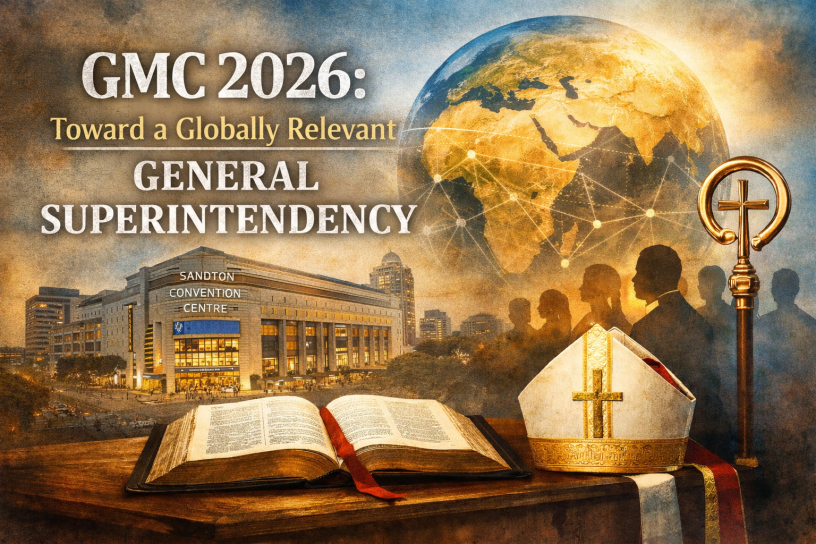
GOING BACK TO A PRE-1939 METHOD OF ELECTING BISHOPS RESURFACES THE CHALLENGE OF PROVIDING RELEVANT EPISCOPAL LEADERSHIP FOR A GLOBAL CHURCH.
by Chris Ritter
The Global Methodist Church is a reform movement that seeks to restore the doctrine, spirit, and discipline of the revival that gave birth to the Methodist and Evangelical United Brethren streams of Christian faith and mission. We seek to reform the church in order to reengage the spread of scriptural holiness that once defined Methodist witness around the world. Reform, of course, is difficult and often conflicted work. Old habits are hard to break. Our mission field is in significant flux. The global nature of our ambition requires us to engage the deep complexity of our world. In short, we have our work cut out for us.
Since all movements rise and fall on leadership, reforms to the episcopacy received significant attention during the GMC’s formation. Several problems were identified with the episcopacy as it existed in our previous denominational expression. First, bishops were styled as general superintendents of the whole church but elected regionally. This often produced an episcopacy out of step with the General Conference. Second, episcopal authority was exercised toward political ends. Third, bishops were elected for life with limited accountability, creating a widespread perception of insufficient responsiveness to the church’s leadership needs.
Yet the GMC was not willing to abandon the historic office of bishop, an office long dedicated to preserving the faith. The uniquely Methodist model of itinerant general superintendents — an office historically understood as apostolic in function — proved remarkably effective during the nineteenth century, when Methodism achieved its zenith of influence. Several key reforms approved at the 2024 Convening General Conference in Costa Rica were designed to strengthen episcopal accountability and alignment. Complaints against bishops would be received and processed by a Global Episcopacy Committee tasked with meaningful oversight. Bishops would stand for re-election and be limited to two terms. Consistent with Methodist practice prior to the 1939 merger, bishops would once again be elected only at General Conference.
A Historic Challenge
Returning episcopal elections to General Conference resurfaced longstanding challenges. There were debated reasons why episcopacy became regionalized in 1939. Some reflected the realities of the Jim Crow South; others arose from the logistical challenges of administering a global church.
The nineteenth century marked a golden age of Methodist missionary expansion. While much good was accomplished, the story is inextricably entwined with Western colonial realities. The Methodist Episcopal Church’s first major organized overseas mission field was Liberia, a West African nation established by formerly enslaved Americans. Missionaries were sent beginning in 1833, but the need for local episcopal leadership soon became apparent. None of the six active bishops could sustain the demands of oversight there.
The 1856 General Conference authorized an extraordinary provision allowing Liberia to elect a bishop who would serve locally rather than as a general superintendent of the entire church. In 1858, the Liberia Annual Conference elected Francis Burns, who returned to the United States and was consecrated by Bishops Janes and Baker at the Genesee Conference session in New York.
Bishop Burns represented several historic firsts. He was the Methodist Episcopal Church’s first missionary bishop, the first bishop of African descent, and the first bishop elected outside General Conference. Unlike general superintendents, his authority was residential and mission-specific.
Subsequent missionary bishops were elected by the General Conference and consecrated as bishops of the church, yet their authority was functionally limited to their assigned mission fields rather than the general superintendency exercised by regular bishops. Among the most influential was William Taylor, elected in 1884 as Missionary Bishop for Africa. Though formally assigned to Africa, Taylor’s missionary strategy shaped Methodist expansion in India, Australia, South America, and beyond. Scholar David Bundy observes that Taylor’s influence was pivotal in extending Methodist work outside Europe and North America. Bishop Thomas Neely later argued that relieving missionary bishops of broader administrative burdens allowed them to focus more effectively on mission leadership.
The Methodist Episcopal Church, South, as well as the Evangelical and United Brethren traditions, assigned regularly elected bishops to overseas work rather than creating a separate missionary episcopacy. These bishops were American-born and exercised general superintendent authority.
By the 1920s, Methodist missions had matured sufficiently to allow more localized governance. The practice of electing missionary bishops gave way to the creation of central conferences — groupings of annual conferences sharing cultural and geographic context — empowered to coordinate governance and elect bishops outside the USA. This structure, while short of full autonomy, marked a significant step toward self-direction. Central conferences also provided a framework that later informed the 1939 reunification of Methodist bodies. The principle that conference groupings could elect bishops was extended to the United States through the creation of jurisdictions.
The Methodist Church formed in 1939 sought to eliminate the appearance of second-tier bishops but did so by embedding regionalism in its constitutional structure. This reassured southern delegates that they would not be dominated by northern leadership. African American conferences, however, were segregated into a racially defined Central Jurisdiction that endured until 1968. The reunification mantra — “unity without uniformity, authority without domination” — captured the aspiration, yet the framework ultimately proved insufficient to sustain long-term unity.
A Present, Global Challenge
If regionalization proved an imperfect answer to real concerns, the GMC now faces the task of crafting a new model. With episcopal elections returned to the General Conference, the convening assembly elected two non-American bishops, both African, among the six new interim bishops. Upon assignment, Bishops Pena Auta and Kimba became the first African bishops to oversee U.S. conferences. The 2025 reception of Bishop Khegay added Eurasian representation. Even so, questions remained about representation across continents and cultural contexts.
Could episcopal leadership effectively span the GMC’s diverse realities? Could a shared Global Methodist identity emerge amid differing expectations of episcopal ministry?
Legislation adopted in 2024 addresses these questions by allowing conferences to group themselves into episcopal areas based on mission partnerships, shared ministry values, or geography. Rather than imposing regional divisions, the system encourages collaborative discernment. (See Episcopal Elections page on the Beauty of Holiness website.)
Eight episcopal areas will be established on May 30, 2026, through an online gathering that includes one clergy and one lay delegate from each conference. Once the episcopal map is approved, eight area committees on episcopacy will convene to interview nominees and bishops seeking re-election. Each area will submit ranked recommendations that will be shared with delegates to the Johannesburg General Conference (August 30–September 5, 2026).
Two Check Marks
In 2024, bishops were elected at-large and assigned by the Global Episcopacy Committee. Beginning in 2026, bishops will be elected to specific episcopal areas by the General Conference. Candidates must effectively receive two affirmations. First, through interviews they must demonstrate alignment with one or more episcopal areas — a test of contextual relevance. Second, they must gain the confidence of General Conference delegates — a test of denominational alignment.
This cycle of forming and filling episcopal areas will repeat every six years, allowing reassessment of partnerships, accommodation of growth, and correction of missteps.
Conclusion
The work before the Global Methodist Church is not merely administrative restructuring; it is the intentional shaping of leadership for a truly global revival movement. Methodist history demonstrates that episcopal structures have always evolved in response to mission realities, cultural diversity, and accountability needs. The current reforms seek to preserve what Methodism has long valued — connectional unity, contextual mission, and disciplined oversight — while adapting to a global future. Whether this model succeeds will depend less on constitutional mechanics than on leaders who embody servant superintendency in the spirit for which the office was created. Reform is never finished work. It is an ongoing act of faith — trusting that Spirit-guided structures can keep the church rooted in its heritage while responsive to the mission ahead.
 People Need Jesus
In reading this post, it makes me wonder how the offices of apostle and prophet could fit with Methodist bishops. Though, a missionary bishop could entail those spiritual gifts. I pray the Global Methodist Church follows the lead of the Holy Spirit in ascertaining the role and functions of bishops from a general church perspective.