

by Chris Ritter
The activities of retired United Methodist clergy have historically been of modest concern to UM conferences. Retirees are required by Discipline (Par. 357.5) to list a charge conference where they may file an annual report of ministerial activities. These charge conferences of record need not even be in the same state where the clergy resides. A good number of retirees ignore the annual report requirement, perhaps feeling they met their quota of denominational paperwork during their active years.
Retired clergy spend their time on all sorts of meaningful work. It is not uncommon for them to fill the pulpits of congregations of various denominations, especially those with extended interim seasons between pastorates. Retired clergy serve as cruise ship chaplains, conduct weddings, and work for funeral homes. I know one retired colleague who was chaplain at a theme park in Missouri. Some find ministry posts overseas. The world is our parish, as we Methodists say. One retired clergy is recently on record as not attending a church at all. He is surely not the only one.
The launch of the Global Methodist Church has brought increased scrutiny on the activities of retired clergy. UM conferences are loathe to see their retirees serve in disaffiliated churches seeking interim leaders. Churches often cherish retired clergy in residence as emeritus, honorary or paid staff. When these congregations disaffiliate, some conferences pressure clergy to choose between their conference and their congregation. In Louisiana, this pressure has grown into overt threats with health repercussions.
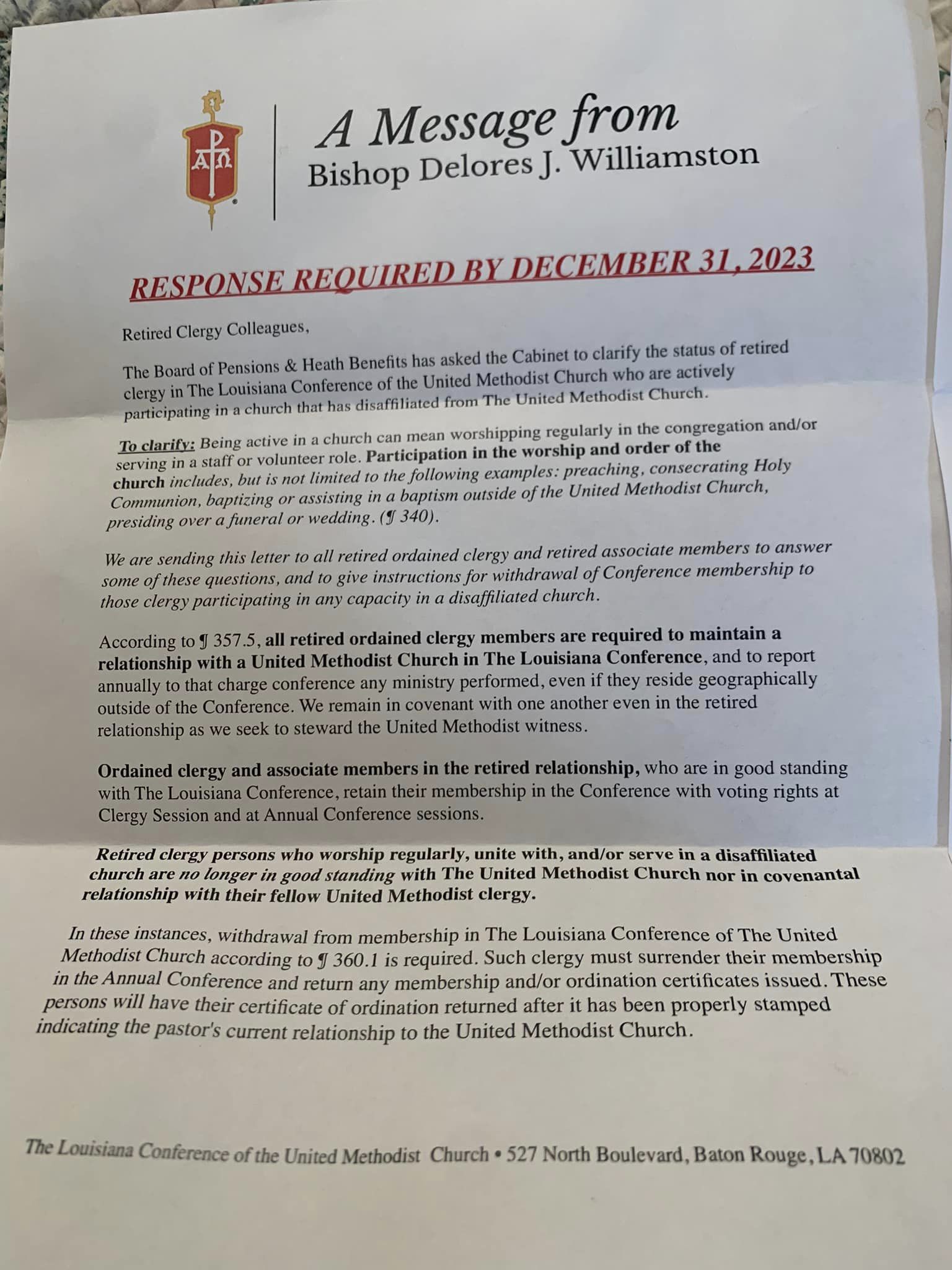
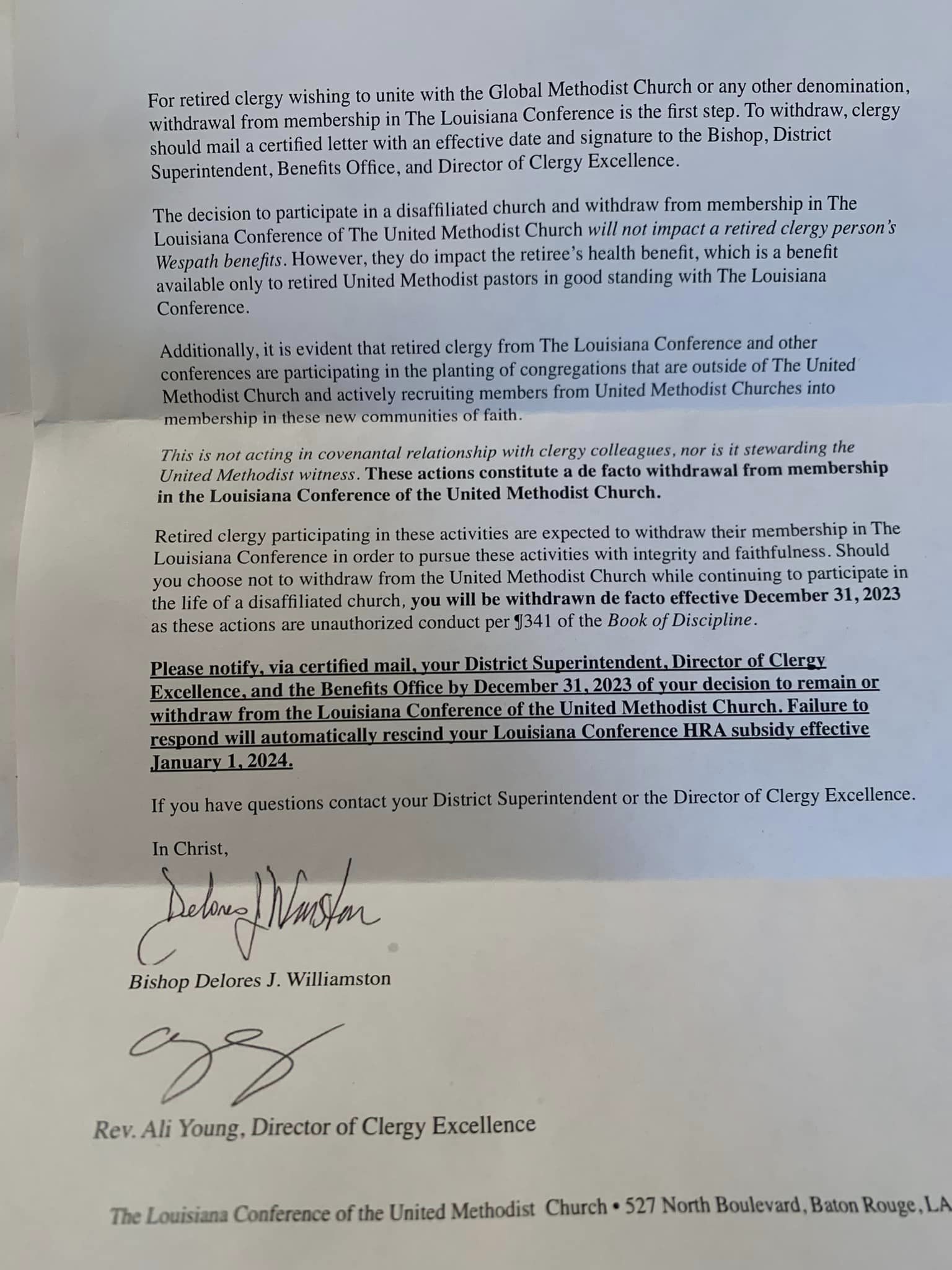
On November 25, Doug Ezell posted, “My heart hurts deeply. Below is a picture of a letter demanding that my credentials in the UMC be surrendered by December 31st and declaring that I will no longer receive my health care benefits if I continue to preach and teach in both United Methodist Churches and Global Methodist Churches. The same is being sent to other retired colleagues.”
The letter from Bishop Williamston, included below, requires retired Louisiana clergy to send a certified letter or lose the conference health benefits they earned through years of service. Failure to do so, she says, will be considered a de facto withdrawal of clergy membership. The bishop cites Par. 341, unauthorized conduct, as the basis for a default withdrawal. But there is nothing in this paragraph about limiting ministerial activities to the UMC [re-baptizing, reorganizing a pastoral charge without permission, and conducting same-sex weddings are listed explicitly.] Ecumenism is a stated UM value. There are, however, several subsequent paragraphs requiring due process when the status of a clergy person is altered.
Wespath, the denominational board of pensions, sets a great example of how to honor years of service in the UMC. Even if a clergy person is removed under charges, their retirement benefits are fully vested and cannot be revoked or used as ransom. Retirees and their spouses rely on benefits like a conference-provided Medicare supplements. It is unconscionable to threaten retired pastors for serving non-UM congregations in retirement, especially given the conference’s mandate to respect such benefits. In “Annual Conference Retiree Health Care Access” (Par. 639.6), Book of Discipline states, “The board [of ordained ministry] or other agency authorized by the annual conference shall respect the health and wholeness of the annual conference’s clergy persons, who have retired… The board or agency shall provide access to Medicare supplement plans and prescription drug coverage plans.” (emphasis added)
Honoring due process and protecting the healthcare of retired clergy should not be a partisan issue. Altering clergy status by episcopal fiat is a dangerous precedent. The “opt-in” nature of the Louisiana requirement means that some older retired clergy could lose their benefits simply because they are confused and/or don’t pay attention to their mail. This seems a mean-spirited, ill-considered strategy. Bishops have established means at their disposal to correct errant clergy who may be doing harm. Threats involving earned benefits, especially healthcare benefits, should be beyond the pale.
 People Need Jesus
Western PA retirees received a similar threat earlier this year. It’s so sad to attempt to restrict kingdom work for no good human reasons.
So, what makes you think some of these “bishops” are human? I have been considering asking KoiKoi if I can attend Monday Luncheons at the former 1St UMC, Warren, PA.
I have been asked to preach on first Sundays at some small UMCes by the D.S. Who told me that he thinks the UMC may have to change their position on who just can administer communion because of the shortages of ordained ministers.
To take away these benefits and seeking to control the ministry of retired pastors is simply wrong.
The blatant hypocrisy of this bishop’s letter/threatened actions is maddening. She ignores the Western Jurisdiction’s blatant and intentional violation of the Book of Discipline in electing two openly gay/same sex married individuals to the office of bishop while she conducts her own petty/vengeful actions with retired UMC clergy. May God have mercy on her soul.
This action in my opinion, is just another sign of a desperate, vindictive, dying, denominational structure. Unfortunately, I believe that it will get much worse. Some within the UMC hierarchy seem hell-bent to insure that every bridge to a possible future reconciliation is destroyed beyond repair.
I have to agree with you. I choose to leave the AL WFL conference when our Bishop sent out a similar letter last year. So good to be free….All retirees will have to make a decision.
Very similar to what is happening in the Dakotas UMC. I did a post on this some time ago how the leadership threatened retirees and widows about staying faithful to the UMC or lose their retirement benefits. Prior to the split, the Dakotas UMC had been fairly liberal (in a positive way) by allowing pastors to continue to receive benefits even if they changed denominations. We even had a pastor become Universalist Unitarian and continue to receive benefits and was celebrated when she passed.
This is apparently a COB policy across the US. I think they are depending on the fact that there aren’t many retired clergy who want to take this on with a trial and judicial council appeal. It is hurtful and needless. Death benefits are also a Conference Benefit which is forfeit to withdrawn clergy.
It is so wrong and anti Christian what they are doing. How dare they tell a retired pastor they can never again pastor and preach the gospel in another church, simply because it’s not a “UMC” or else they’ll lose their hard earn retirement benefits. Shame on them and may God deal harshly with them.
Article from March 7, 2023
I have to ask if a qualified lawyer with ecciastical bono fides has researched “due process” and “shepardized” for cases decided by the UMC Judicial Council relating to these “post retirement issues?” Indeed, the casual enforcement of the reporting requirements with UMCs in retirement to be sufficient to support estoppel of their arbitrary use against disaffilating clergy.
Our secular courts will intrude where the issue is sufficiently related to elementary justice, despite the evil cloaked by a malign religiosity.
Put on the armor and remove the sackcloth and ashes! Ephesians 6:10-18
March 7, 2023
https://wesleyancovenant.org/2023/03/06/disaffiliation-trends/