
by Chris Ritter
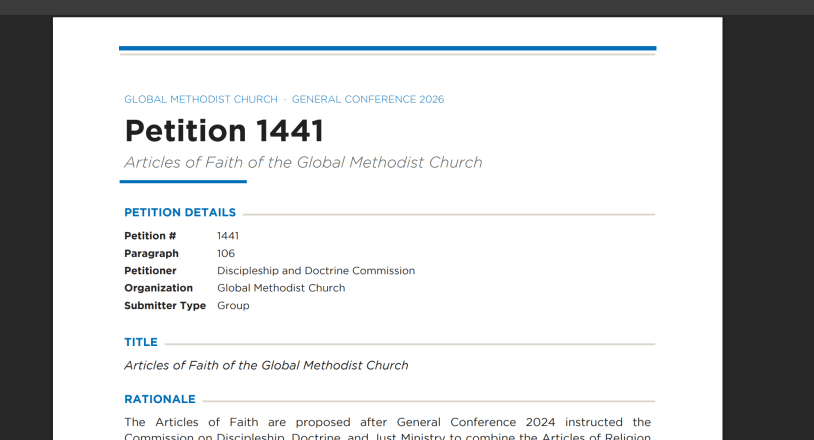
I want to express my sincere appreciation to the Discipleship and Doctrine Commission and everyone else who has contributed to the proposed revision of the Global Methodist Church’s Articles of Faith.
This is a remarkable achievement.
The proposal faithfully articulates the core doctrines of historic Christianity through a distinctly Wesleyan lens. As a pastor, I look forward to having these updated Articles as a congregational resource. As a lifelong Methodist, I am grateful for the theological clarity they provide, and I hope they will serve our church well for generations.
Because I hold the work in such high regard, I offer one suggested revision—not as a criticism of the project, but as a contribution to the conversation before General Conference.
The sentence in question appears in Article VII:
“Qualified men and women are ordained for ministry in the Church by bishops through the laying on of hands.”
As chair of the Global Episcopacy Committee, I fully support the Global Methodist Church’s current practice of bishops ordaining elders and deacons. My concern is not with our polity. Rather, I question whether this particular statement belongs in our doctrinal standards.
Historically, Methodists have distinguished between doctrine and church order. Our doctrinal standards confess what the Church believes concerning God, salvation, Scripture, the Church, and the sacraments. Questions regarding who performs ordination have generally been addressed through the Book of Doctrines and Discipline rather than through the Articles of Faith themselves.
Indeed, our Discipline already provides that bishops ordain clergy. That is an appropriate and necessary provision of church order. My concern is that placing this requirement within an Article of Faith inevitably raises broader ecclesiological questions.
What is a bishop? Why is a bishop uniquely authorized to ordain? Does episcopacy become a constitutive mark of the Church? Does this imply that bishops constitute a distinct order of ministry?
Historic Methodism has generally answered these questions differently than Anglicanism or Roman Catholicism. John Wesley understood bishops and elders to be the same New Testament office, differing in function rather than order. Across Methodist history, bishops have ordinarily been understood as elders entrusted with particular responsibilities for the good order of the Church—not as a separate sacramental order.
I do not believe the proposed language intends to make a different claim. My concern is simply that the wording may unintentionally suggest one.
Likewise, Methodist history demonstrates that ordination has not always been exercised exclusively by bishops. Wesley himself acted in extraordinary circumstances, and British Methodism today understands ordination as an act of the Conference. These examples do not argue against our present practice, but they do illustrate that historic Methodism has not regarded episcopal ordination as essential to the validity of ordination itself.
If the purpose of the sentence is to affirm that both men and women may be ordained—and I believe that is its primary purpose—I wonder whether that affirmation could be made without constitutionalizing who performs the act. For example:
“Qualified men and women are ordained for ministry in the Church through the laying on of hands by those so authorized.”
Such wording preserves the Church’s affirmation of ordination while allowing the Discipline to specify that, in the Global Methodist Church, bishops are those authorized to ordain.
Ultimately, my concern is one of restraint. Every sentence included in the Articles of Faith carries constitutional weight. They are intentionally difficult to amend because they define the Church’s enduring doctrine rather than its current administrative practice.
The question, therefore, is not whether bishops should ordinarily ordain in the Global Methodist Church. I believe they should. The question is whether this practice should be elevated to the level of a doctrinal standard. Do we believe that those denominations who ordain another way—British Methodists, Wesleyans, Baptists, and many others—are in theological error? I do not believe that we do.
Reasonable people may disagree, and I respect those who have reached a different conclusion. My admiration for this project and for those who have undertaken it remains undiminished. I simply believe this one sentence could be be improved by preserving a distinction that Methodists have historically held dear: the distinction between what the Church must believe and how the Church chooses to order its common life.
I look forward to the conversations ahead as our church prayerfully considers these proposed Articles of Faith.


is this tentative to dogmatize episcopacy a sort of ‘ecumenical olive branch’ to similar groups with a focus on ‘historic episcopate’, for example ACNA?
Hello. Thanks for reading and for the comment. While my amendment is not intended as an olive branch, it certainly would not be gracious of us to declare the ordinations of British Methodists (and other Wesleyan groups without bishops) as invalid. Most of us have lines of ordination that flow through Wesley, who was not a bishop.