
by Chris Ritter
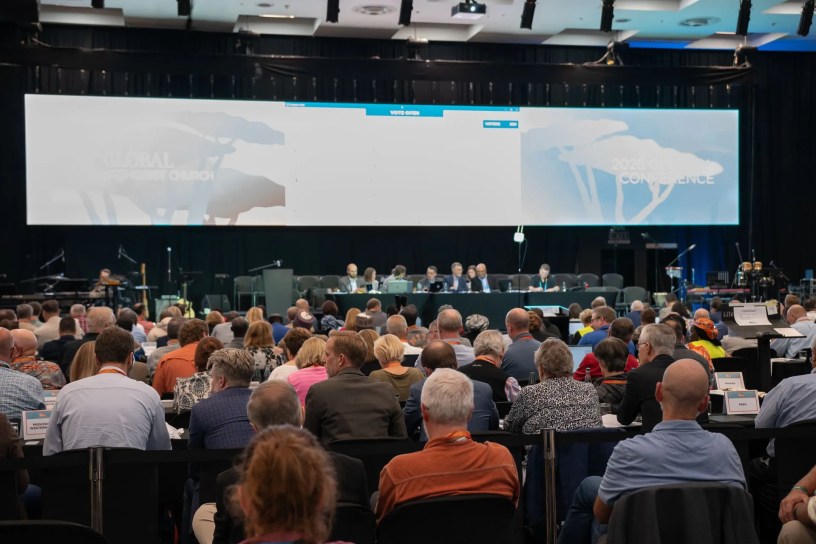
The Holy Spirit visited us in so many ways during the first regular General Conference of the Global Methodist Church in South Africa. It was a holy and focusing time for our movement.
I regret that time did not allow me to chronicle the work day by day on this site. But some of the biggest victories, reported by others, bear repeating here.
The Articles of Faith were approved 370 to 1. To achieve that level of unanimity on something as intricate and nuanced as doctrine is remarkable. The worship, mission work, and thoughtful adjustments to our polity were each signs that our new denomination is committed to keeping the main thing the main thing. We formed a covenant with the Methodist Church of South Korea, advancing our relationship in the wider ecumenical world.
Another victory was the election of eight full-time bishops to lead the church. I know them all and have great confidence that each will lead the GMC’s mission with passion and integrity. It was one of the great honors of my life to chair the election process, report to General Conference, and present those elected for consecration.
Because of the rush to finish our legislative work on Saturday, I very likely left some with the impression that I believe the revisions to our episcopal election process are flawed. That is not the case. While I find one facet disappointing, I truly believe we ended up with a process of integrity that the Holy Spirit can use well as we approach the 2032 elections. Erik Grayson and his team of officers did a superb job leading our Superintendency Legislative Committee, despite our struggles with technology and an enormous amount of work to complete.
What We Got Right
I celebrate that we retained the process of forming episcopal areas in the months before General Conference. This gives us several Area Committees on Episcopacy that can interview and vet the nominees. In 2032, these committees will not rank candidates before the election. Instead, each will submit a pool of nominees it believes should be elected, with the number of names equal to the number of bishops to be elected. When delegates begin voting, they will benefit from the discernment of these independent groups.
We also made improvements to the timeline that align well with what the Global Episcopacy Committee actually used in the lead-up to 2026.
We kept the overall nominee pool lean by retaining the requirement that each conference delegation nominate only one person from its own conference and one from outside its conference. There was a motion to allow each conference to nominate up to four people. In my view, this would have unhelpfully flooded the field.
Supporters of more nominees, however, were motivated in part by a desire to see more women nominated. We have such a deep bench of talent among our female clergy that I believe we can and should see more women elected as bishops in the future. Perhaps delegations can keep this in mind when making their nominations for 2032.
There will also be no “qualification ballots” next time around. This was a wrinkle unique to our transitional season and one that prevented Bishop Leah Hidde-Gregory from being considered for re-election. She received 73.3% support—a remarkable number, but just shy of the 75% required for an interim bishop to be considered again. I am glad the days of “interim,” “provisional,” and “transitional” polity are now behind us.
So Why Did I Speak Against the Legislation?
If I believe the new election process is fundamentally good, why did some from the Global Episcopacy Committee—including me—stand to speak against it on the floor of General Conference?
It all comes down to assignment.
This year, the process called for General Conference to elect and assign bishops in a single action. Following General Conference 2024, by contrast, episcopal assignments were made by the Global Episcopacy Committee.
In the days before the election, some members of our legislative committee believed the untested idea of electing bishops to specific episcopal areas was confusing and unnecessary. As the author of that process, I believed it could and should work. But I, too, had some doubts.
After substantial debate, a subcommittee retained the assignment of bishops to areas by General Conference. Back in the full committee, Jay Therrell offered an amendment returning the assignment process to the Global Episcopacy Committee. In my speech on the amendment, I told the committee that his proposal was completely reasonable. I also admitted that, coming into General Conference, my own preference for assignment by General Conference was probably only 60%. I worried that electing a pool of bishops would subject us to the influence of voting blocs that could dominate the elections.
By a wide margin, the Therrell amendment was approved in committee. I was at peace with that decision. There was a very narrow window in which those who disagreed with the legislative committee could file a minority report. I decided to let it go.
Then we held the elections.
The election-and-assignment process went better than I could have hoped.
We chose half of the needed bishops on the first ballot, and the entire process was soon completed in a spirit of unity and excitement. Some had worried that the ranking process would make the election a fait accompli. But the body used the full rankings to do its work. It was no rubber stamp of each area’s top choice. All nominees were on the ballot and received due consideration.
People rushed to greet their newly elected and assigned bishops. In the hours that followed, I witnessed beautiful, holy bonds beginning to form between bishops and the people they had been selected to serve.
Delegations met with their new bishops to share their hopes and needs. Outgoing bishops began speaking with those newly elected about the strengths and challenges of the conferences they would lead. Relationships began forming immediately.
Watching all this unfold reaffirmed my support for assignment by the General Conference.
I came to believe there was something worth preserving in those countless interactions—something that could give our new bishops the best possible start to their terms of service. Under the newly adopted process, General Conference could conclude with no one knowing which bishop would ultimately be assigned to which area. To me, that feels like an opportunity lost. I wished we could have experienced this part of the process as written before we tried to fix it.
What Happened on the Floor
On Thursday, there was a lively email and text conversation among members of the GEC about the pending election legislation (revised Par. 604). Some were recommending an amendment. Just at that moment, Chairman Erik Grayson was called to the front to present the legislation. I asked General Conference to delay action until Friday, and the body widely supported that request. Some members of the legislative committee understandably wondered what I was up to, so I explained my concerns to them by email.
No action was taken Friday amid the busyness of elections to our Connectional Councils. One of our GEC members then authored an amendment that would return the assignment process to General Conference.
But when Saturday arrived, we were seriously short on time. The amendment included four replacement subparagraphs that were not successfully displayed on the screen. Don Bourland, a member of the GEC, was relying on the amendment being projected as he spoke. There was no foul play—only the crunch of time, technological difficulties, and many other important matters demanding the body’s attention.
General Conference overwhelmingly approved the petition as amended by the legislative committee.
If you loved assignment by General Conference, I take responsibility for not offering that alternative earlier as a minority report so the body could consider it properly.
If you like the new election process, I like it, too. I will use whatever influence I have to help make it work very well.
I am honored to have been elected to the Global Episcopacy Committee for another six years. While I have no intention of chairing the committee for a full sexennium, I believe deeply in the work. All those elected to serve on the GEC will be extremely conscientious in carrying out the assignment responsibility entrusted to us. You have entrusted the GEC with even greater responsibility and none of us take that for granted.
There may even be ways to preserve some of what was good about the 2026 experience. If the General Conference Commission agrees to include the entire GEC at General Conference 2032, perhaps Area Committees on Episcopacy could provide feedback quickly enough after the election for the GEC to make assignments during General Conference. A method like that—somewhat reminiscent of the way UMC jurisdictions make episcopal assignments—may or may not prove advisable. But it is one of many possibilities worth considering.
I am sure all of this will become part of our election post-mortem as the Global Episcopacy Committee welcomes its newest members and begins thinking toward 2032.
Gratitude
Thank you for the trust and input extended to us throughout the 2026 episcopal election process. Hundreds of hours of prayer, discernment, conversation, and work were contributed by conference delegations, the plenary gathering, Area Committees on Episcopacy, the Global Episcopacy Committee, and the nominees themselves.
Rhonda Bourgeois contributed a tremendous amount of volunteer work disseminating information and organizing our files on Atlas. The GMC Communications and Translation Teams provided excellent support throughout the process. Many others gave time and energy behind the scenes.
No election process designed by human beings will ever be perfect. Nor should we expect a process to do the work of the Holy Spirit for us. Good polity simply creates trustworthy space in which prayerful discernment can happen.
We have a strong process for 2032. We learned a great deal in 2026, retained the most important parts, made changes, and gained experience that no legislation could have given us in advance.
Six years from now, we will come to the task wiser.
And, by God’s grace, just as dependent upon the Holy Spirit.

